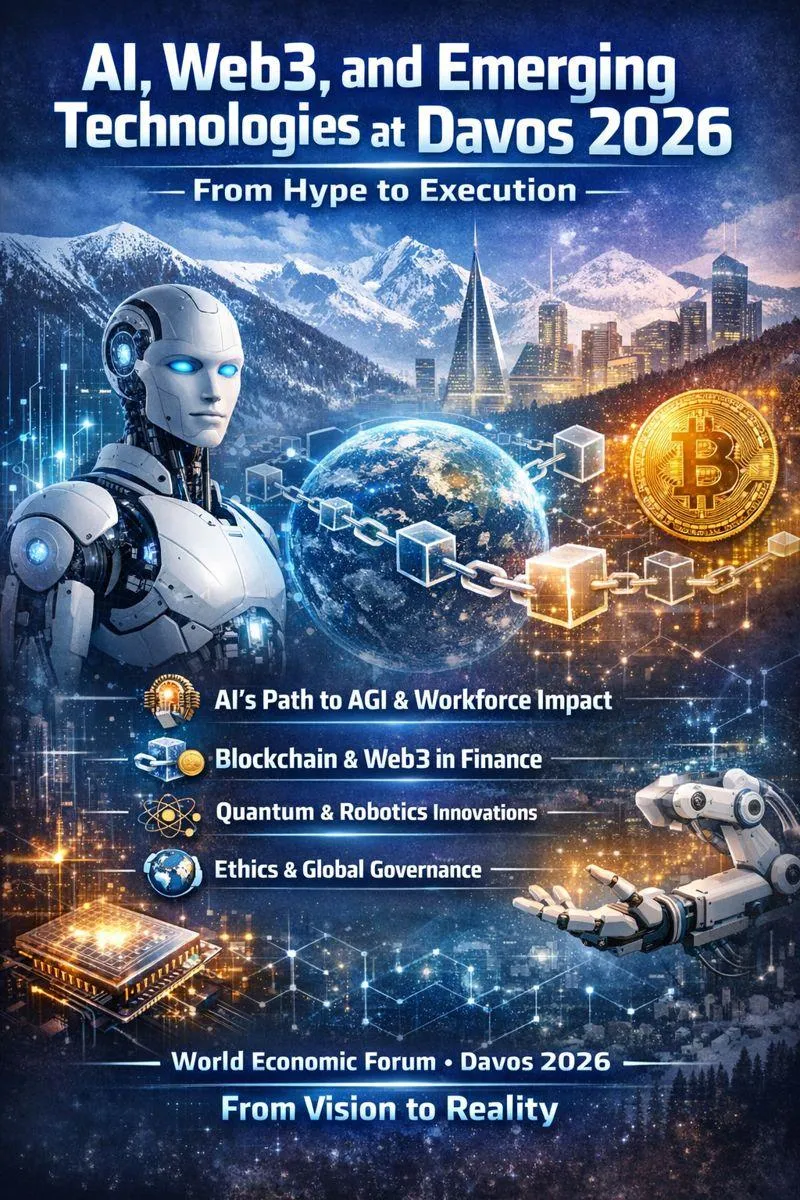
AI, Web3, and Emerging Technologies at Davos 2026: From Hype to Execution
The World Economic Forum (WEF) Annual Meeting 2026 in Davis marked a clear inflection point for emerging technologies. Under the theme "A spirit of Dialogue" and the guiding questions "How can we deploy innovation at scale and responsibly?", discussions moved decisively away from experimentation and toward real-world execution. Artificial intelligence, blockchain, Web3 and adjacent fields such as robotics and quantum computing were no longer treated as speculative trends, but as foundational economic infrastructure shaping the next global cycle.
AI: Scaling reality, not promises.
AI dominated Davos 2026, with consensus that technology has entered its "industrialization" phase. Executives and policy makers agreed that while pilots abound, scaling AI across enterprises and societies remains challenging. Key constraints include compute infrastructure, energy consumption, data governance and workforce readiness. The concept of AI sovereignty emerged as a strategic priority, emphasizing domestic investment in capital, skills and public-private partnerships to maintain competitiveness in an increasingly fragmented geopolitical landscape.
Timelines for advanced AI also converged dramatically. Elon Musk predicted AI would surpass any single human by the end of 2026 and exceeded collective human intelligence by 2035. Leaders from Anthropic, DeepMind and other frontier labs echoed similarly accelerated views, driven by advances in autonomous agents and self-improving systems. While opinions varied on exact dates, the message was consistent: transformative AI is no longer decades away.
Workforce impact was another central theme. Panels acknowledged estimates that up to 40% of current jobs could be disrupted globally, yet the dominant narrative shifted toward job creation and reskilling. As AI and robotics costs fall, "physical AI" was framed as a new employment engine - provided governments and companies invest aggressively in education and transition pathways. Ethical concerns, from mental health risks to value alignment, underscored the need for governance alongside innovation.
Blockchain and Web3: Finance goes on-chain
If AI represented cognitive infrastructure, blockchain emerged as financial infrastructure. At Davos 2026, crypto and Web3 were no longer fringe discussions but core to conversations about monetary systems, capital markets and resilience. Stablecoins were widely treated as policy-relevant instruments rather than niche tools, with panels discussing their role in payments, cross-border settlements and even sovereign monetary strategy.
Tokenization of real-world assets (RWA) was another major milestone. Leaders such as BlackRock Larry Fink pointed toward a future where equities, bonds and funds are issued and settled on unified blockchain rails. Wall Street's growing participation signaled a transition from pilots to production, with institutions viewing blockchain as low-energy, high efficiency infrastructure rather than speculative technology.
Web3 forums at Davos highlighted the convergence of decentralization with enterprise adoption. From JPMorgan's live blockchain deployments to discussions on AI-blockchain intersections in geopolitics and workforce design, the focus was firmly on operational systems, not concepts. Even disruptive voice, such Binance's CZ, who advocated "offending traditional banks", framed their arguments around real payment efficiency and financial inclusion rather than ideology.
Beyond AI and crypto
Quantum safe cybersecurity and robotics rounded the agenda, reinforcing a broader message: the next decade will be defined by overlapping technological waves. Preparing cryptography for a post-quantum world and integrating AI with robotics were seen as both risk mitigations and growth opportunities.
A turning point
Davos 2026 did not deliver definitive answers - but it marked a shift in mindset. Innovation is no longer about vision alone, it is about execution, governance and scale. AI is becoming economic bedrock, blockchain in reshaping finance, and human-centric design is now a strategic necessity.
The dialogue continues, but the direction is clear: the future is being built now.
As we navigate the complex interplay of innovation, governance and societal impact highlighted at Davos 2026, AWAA remains steadfast in our commitment to advancing the responsible, inclusive and sustainable adoption of blockchain, Web3, AI and related technologies across Asia. Our mission is to foster collaboration, education and strategic leaderships that empowers governments, enterprises, startups and communities to harness the full potential of frontier technologies for shared long-term growth. In doing so, we strive to shape a digital future that drives sustainable development and meaningful impact throughout the region.
